
Chapter Text
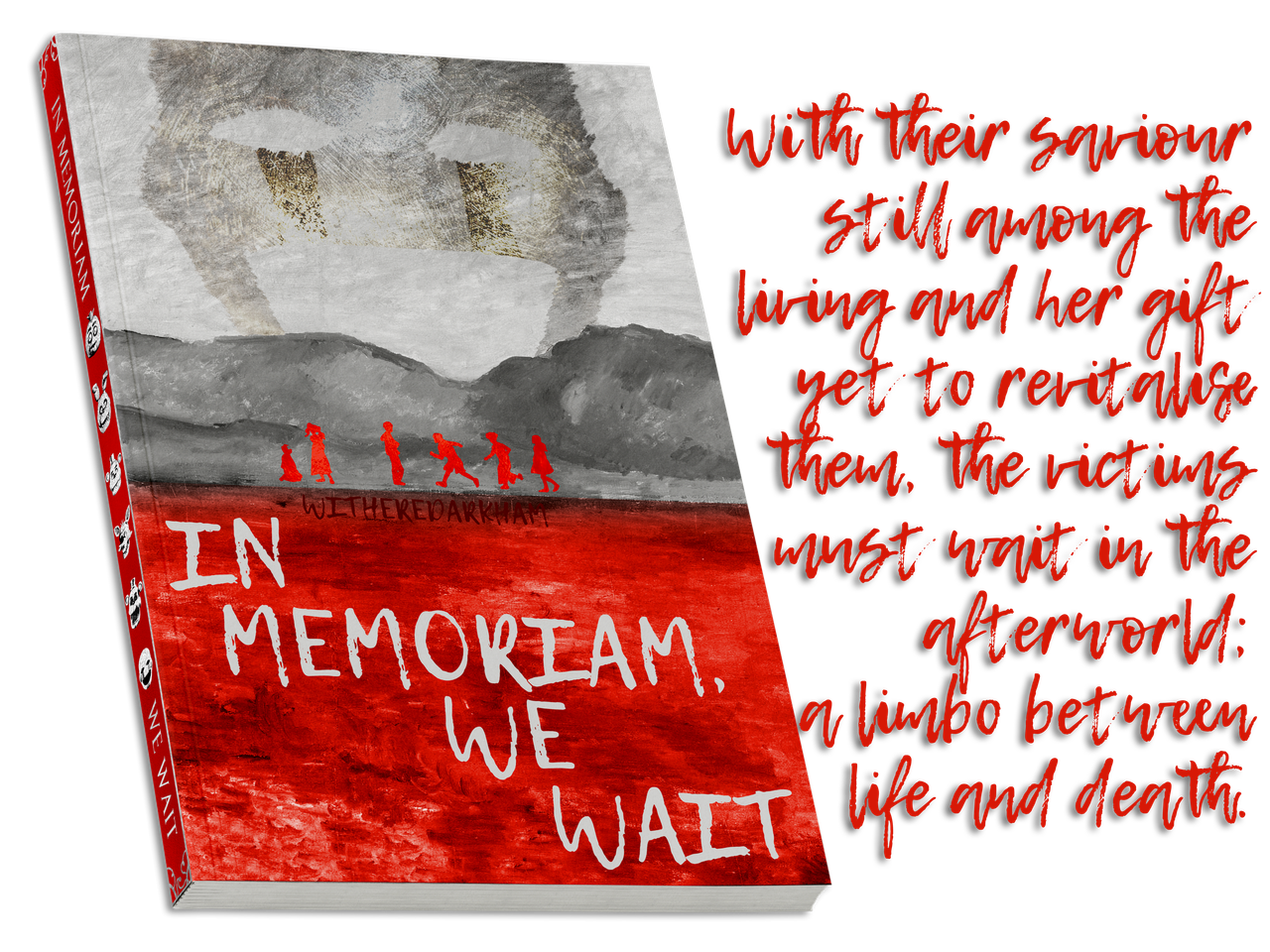


Animal death – Description of Susie’s dog after death; not extremely detailed
Blood and Injury – Mentioned multiple times; detail may vary
Child abuse – Kids get severely hurt; detail may vary
Death and dying – Extensive discussion about death
Gore – Only when describing the Crying Child (post Bite of '83)
Kidnapping and abduction – Duh, this is FNAF; extensive discussion
Violence – Mention of struggle, murder, and bullying; detail may vary

CHAPTER ONE : Primus inter pares
CHAPTER TWO : Luctor et emergo
CHAPTER THREE : Corpora lente augescent cito extinguuntur
CHAPTER FOUR : Non desistas non exieris
CHAPTER FIVE : Silentium est aureum
CHAPTER SIX : Servire et servare


The world is barren.
Grey stretches out before her, horizonless. Devoid of any vegetation, the ground she treads is solely cracks and fissures. Not so much as an aimless insect, or a tuft of grass, or even a deciduous tree within sight. And no wind to whisper either.
Where is she?
With no sense of direction, she squeezes her eyes and spins on her heel. There. That way. Her skin crawls as she walks into the nothingness. Something is wrong. The dread, the trembling little hands, the pounding of her heart—faster and faster like a rabbit’s.
Rabbit, she thinks with a lump in her throat. Rabbit, rabbit, bunny rabbit. What is that about? She racks her brain, blinking with considerable effort. For the life of her, she cannot understand why the word makes her tremble. Why, it is the most unassuming animal of all. Prey for beasts, she knows, having frequently been moved to tears by the nature documentaries her father watches to fall asleep. Meat for hunters, which she had once tasted with a frown when her grandfather brought it home, finding it inconceivable that such a furry creature could be so thoroughly gutted as to become a brown heap upon her plate. What happened to its heart? Did they throw it away? She wouldn’t have thrown it away.
Panic comes in intervals. Washing in waves over her, springing her into action like a hunted creature. Who is she running from? Where is she going? Soon, in all likelihood, she will stumble upon a house or a person. She will explain how she woke up here, amidst the fog, drowned in its silence, utterly disoriented. She will stress that her parents must be waiting at home. That she must put her dolls to sleep—they can’t, unless she tucks them in. That her grandmother makes hazelnut cookies each Sunday, and they will wait, arranged on an oval plate, with cracks traced through them like the ground she walks upon now. And her homework. Oh, she must hurry now. There will be no time to complete it before school if she spends her day aimlessly walking.
A memory appears in the forefront of her mind. Fur brushing her knees. A wet and coarse button nose wiggling. A strident bark. Her dog, she recalls with a sense of dread. What is his name? The idea that he could be out here, crying, and she would not be able to find him is mortifying. She quickens her pace. At some point she will collapse. Her feet will burn, her knees will quiver from exhaustion. And when that happens she must endure, because she must find him. Where could he be? He couldn’t be hiding the way he does at home, napping lazily between shrubs after an enthusiastic pursuit of squirrels. He’s a loud little thing, always panting and barking. The one time he was silent was during an ailment, and he barked with effort, as she brushed his matted fur. He must be here, because she is here, and he wouldn’t leave her alone for nothing in the world.
She never does collapse from exhaustion. There isn’t even a bead of sweat on her.
“There's no point. You’re going nowhere.”
“Who’s there?” she asks, tense as she surveys her surroundings. Nothing but a puffy fog, denuded land.
The voice is juvenile, of that she is certain. Where did it come from? There is no indication of another presence, or the unbearable feeling of another's eyes tracking her. She heard him within the confines of her mind, more so than in actuality—he and his hiccuped breaths, and his sniffles. Was he also lost? Did he seek a way home, too?
“Where are you?” she asks, frustrated and dizzy from spinning.
More crying. It is strained. Gurgling, even. The boy could make rivers of these fissures. Perhaps, if he cries long enough, they could sail away. She settles on the ground, careful not to bunch her skirt, precisely as her mother had taught her. She will wait for as long as she has to. And after, his focus will return to their true goal: leaving this place.
“What’s your name?” She tries some time later, tracing a crack in the ground with her finger. His cries are inexorable.
Upon closer inspection, the inner bands of her fingernails have been painted red. Not the shade of red her mother favours on her own fingers, like ripe cherries. No, this is a shade verging on brown. Were the colour to possess a smell, it would undoubtedly be that of a rotten apple. But she perceives no smell. This abyss smells of nothing at all. She wipes her hand on her skirt. What if her mother sees and chastises her for it? After all, she had been warned to stay away from her mother’s cosmetics, especially the nail polish.
“I don’t know.”
“You don’t know your own name?” she puffs, still smearing the red away. He has an accent, one that she feels she has only ever heard in daytime soap operas with regency ladies.
“Do you?”
“Of course! I’m named after my grandmother. She is probably worried sick about me. Do you know how to get out of here?”
“There's no exit.”
“That can’t be right,” she mutters, looking around. “We came here somehow.”
“My father,” the boy takes a moment to sob, his voice ebbing in and out, “he will find us. He always finds my hiding spots.”
“Well, you can wait for your dad, then. I have to go.”
“And where will you go?”
“Home. What a question. Where else would I go? I have school tomorrow, I have to sleep or I’ll be groggy all morning. Do you know how hard I work to get the grades I do? How could I do that if I’m here, wasting my time walking around?”
“I never went to school.”
“Oh?”
“My brother taught me at home. He would punch my friends if I got an answer wrong.”
“That’s awful. At least you have friends to worry about.”
“He ripped Foxy’s head off. The sound it made,” a pause, followed by more sobbing, “I couldn’t save him.”
Foxy. The Pirate? The fictional pirate fox from her morning cartoon? His life must be more depressing than she initially believed if his only friends were inanimate. An irksome guilt now resides within her ribs—she is being awfully defensive with one who, in all likelihood, lacks the courage to appear before her.
“Where are you?”
“I don't know. I can't see.”
“Can you walk towards my voice? I can meet you halfway.”
“No, no. I have to stay here. My father said he will put me back together.”
“What does that mean? Are you hurt?”
She springs to her feet. Should he be injured, they must find help now. Her father always stressed the importance of sanitising wounds. He is a doctor, always away on house visits and rarely ever in his own home. But there is hardly a pebble in sight, let alone clear alcohol. Stopping bleeding and creating makeshift casts with sticks and torn cloth are things she can do even at her age. If the boy's injury is of that calibre, she will be ready.
“I can't feel anything.”
Admittedly, she is similarly devoid of all sensations. A touch of the ground, which should undoubtedly be frigid, feels like nothing. The smell, which she imagines would be like that of a forest after rainfall, is not present either. Presumably, she could not taste, albeit there is nothing around to test that with. This revelation, however, she keeps to herself. This boy is a crybaby. Realising such things would only perpetuate his panic.
“Tell you what, I will walk some more and you can tell me what you remember last. Then, I'll do the same. Maybe we can jog each other's memories.”
“Okay.”
“Alright,” she spins once more, taking off in a random direction. “What happened to you?”
“My brother was dragging me somewhere. He said I was useless. I think we were visiting my father at work. I was crying.”
Do you ever stop crying, she wants to ask. Again, she refrains from doing so. It seems he has suffered enough insults for a lifetime. This brother of his, what a menace. She pictures a lanky and scruffy boy, older than her and rather pleased with the fact. He probably sports a scowl everywhere he goes, and considers himself too cool to smile. She has met his sort at school. They’re insufferable.
“Then what?”
“It was my birthday. Mother made a cake with vanilla frosting. I liked that frosting. She didn't let me lick my finger when I swiped at it. Then Mike threatened to shove my face in it. He always says he will, but he never does. He only punches my friends. I think father will hurt him if he lays a hand on me.”
“Mike is your brother?”
“I have a sister, too. Elizabeth. She looks like you, but her hair is straight.”
She blinks in dismay. “You can see me?”
“I don't. I just know.”
“You just know.”
“Yes, that is what I said.”
Ridiculous. This boy is ridiculous. He has proven utterly unhelpful in her attempt at escape, and now he speaks as if he was everywhere and nowhere. Why won't he simply come out? He remembers names, but not his own. For crying out loud, he hasn't done anything besides weep. Perhaps his brother is correct: of what use is he?
“Lizzy is the one that calms me down. I sleep in her room sometimes. It's pink. She loves pink. Mike yells at me, but he never does so to Lizzy. It's not something father taught him. He just does that. He actually listens to what she has to say, instead of shoving her around. Why is that?”
She frowns. “You’re not supposed to hurt girls.”
“Maybe you’re right. He never does that to Charlie, either.”
“Who’s Charlie?”
“My friend. She sleeps over at our house sometimes. Her father works with my father. They make robots together. She hates that place as much as I do. Mike and Lizzy don’t. They want to follow in father’s footsteps. I don’t know why.”
“Robots?” she wonders out loud. “What kinds of robots?”
“My friends.”
“As in Foxy and the rest?”
“Yes.”
She racks her brain again. There is a brown bear who bears no introduction—he is the headliner and emblem of the restaurant. A cardboard cutout of him welcomes customers along with their security puppet, and for the ones who are tall enough, they can honk his nose. An indigo rabbit strumming an electric guitar comes to mind. A fearsome red fox adorned with an eye-patch, waving his hook around animatedly as he relays a story of his treasure-hunting days. One yellow chicken gushing about pizza, casting her cupcake from table to table, cheering up children. These are the boy’s friends, as he called them.
His father is their creator.
“What were their names again?”
“Freddy, Bonnie, Chica, and Foxy.”
“I’ve been there. At the restaurant.” She stops promptly. “I think I was crying, too?”
“About what?”
“I don’t know,” she sighs. There are dark spots in her memories, like someone scratched the film strip. The arcade room is her favourite, although she dislikes how greasy the controls are. Couldn’t kids wipe their hands after eating pizza? It is disgusting. The hygiene at that place is simply appalling.
“Mike says I cry too much.”
“Well don’t listen to him. My dad says it’s good to cry. It makes you stronger.”
“How so?”
“It takes strength to show everyone you’re scared. Only cowards hide.”
“I don’t feel strong.”
“Well, if you come out, I can help you.”
She can be strong for both of them. To the best of her recollection, she is without siblings. Perhaps, for a time, she might regard this boy as her kin, and he, in turn, may pretend that she is his sister.
“You know, I always liked that yellow one.”
“Chica?”
“No. The other one. From the old restaurant. I never went myself, but I’ve seen the cartoon. What was its name? The yellow bear. Was it Freddy? Remember when he was on posters everywhere? You couldn't leave the house without seeing —”
A wailing. Loud and unabashed. It's as if she had struck him with as much force as she could muster. Just when he had begun to calm down, there he goes again, crying so hard that her ears start ringing.
“What? What? What are you crying for?”
“No,” he says, but his voice is much clearer. It is no longer a cavernous echo. He sounds as though he may be just behind her, or might emerge from thin air. “I don't want to go!”
“Go where?” She yells, trying to hear herself over him. “Calm down! This isn't helping anybody!”
“I don't want to go!”
She falls to her knees, hands firmly clasped around her ears. His screams are brutal. Once, at a sleepover, her friend had swiped a horror movie from her sister's room. She didn't want to watch, but all the others encouraged the insertion of the video cassette. It's fake blood, they laughed, why are you scared? Their screams are rehearsed. Look at how realistic they sound. It's like they're actually dying.
The boy would put them out of work if they could hear him. It would be a miracle if his vocal cords are intact by the end of this.
Something else begins to happen. The fog, she realises, had gyrated around her. Was that his deed? Was the grey abyss responding to their distress? Was that what it took to see the world for what it was?
When he stops, the silence is deafening. It is such that even the rustle of her own clothes startles her. A crunch echoes; like the kind when you’re eating meat and bite into something chewy. It rises bile to her throat. What was that? She surveys her surroundings—still no celestial bodies in the sky, and still a grey bunch of nothing. But, the horizon is visible now. And the ground? Red. An overabundance of red. She thumps her foot to test it. It is as hard as before, arid. Nothing has changed save for its colour.
At once she pivots. A rustle comes from behind. The boy—he is here at last. Blue shorts, a black shirt with two white stripes across his chest, and dull brown sneakers that have seen better days. He hobbles, drifting as though struggling to maintain balance. And yet, his approach holds a far greater morbid fascination.
A whole chunk of his head is missing.
Something had made a window into his head. Of course he can’t see, she thinks. It reminds her of a burger, when she'd take a bite and expose the pinkish minced meat of the patty. The thought disgusts her, and if she could, she would unleash the contents of her stomach right then and there.
“I told him no,” he shrieks, approaching. For a moment she braces herself, fully expecting that he might lunge at her. He does no such thing. He collapses by her feet like a wounded dog, wailing. “I didn't want to go!”
A wounded dog.
A wounded dog?
A dog.
Her dog.
Susie lost her dog.
He was in an undignified pursuit of the mailman that morning. Stupid, stupid dog. Was he deaf to the car’s approach? She cried so much her eyes could have fallen out. Could he not have remained home where he had food, a comfortable bed, a family that loved him? What did he need to bark at the mailman for?
They buried him in a shoebox in the garden. The grief proved insufferable. A void had been torn into her very being. Her mother dragged her upstairs, admonishing her to keep it together or there will be repercussions. And she tried. Susie really tried. With each fleeting shadow, she imagined his return, bounding towards her, entangled in her feet, barking and sniffing like he was seeing her for the first time.
She went to Freddy's. That was her favourite place in the entire world. Susie could get lost in the cheesy slices, the upbeat melodies, the neon arcade. She played hopscotch with her peers as the band, radiant and unreachable, sang to the crowd. She waited for her father's shift to end, so together, they could return home. Maybe then the emptiness could fill. He has to come back soon. There are sick kids, yes, but she is sick, too. Something is wrong.
There was someone behind her. His reflection mirrored on her screen.
He's not really dead.
He is over here.
Follow me.
The rabbit. The yellow rabbit. He lured her away from the children, away from the ruckus. Distraught, engulfed in sorrow no innocence should bear, she listened. Why did she go? She had felt the limpness, seen the blankness of his eyes. Of course, he's dead. She buried him.
“I didn't want to go,” the boy repeats, choking on his own sobs.
Susie, that is her name, palms at her back. Panicked hands flow over her shirt, over the cuts. A hole. There is a hole in her back.
There he had impaled his knife. He talked in a funny way—accented, much like the little boy. She heard the door click, and in the darkness of the room she thought her dog could never be silent in such a place, unless he was stuffing his face in a food bowl somewhere on this checkered floor.
Her ribs were searing hot. Blinding white. A scream. Her scream. The rabbit watched in silence as she collapsed. She, who hadn't seen her tenth summer. Who still smelled like a dead dog. Who had homework due. Who couldn't wait around in the deafness of her home. Who watched a little animated character fly across a maze just minutes before. She, who followed him.
“Get up,” she says, suddenly breathless. The memory of her death shakes her into action. She sees herself die on repeat. Collapse, collapse, collapse. “Get up!”
The boy cries harder. She seizes him by the collar, careful not to touch his face, or what is left of it, lest his brain falls out.
She had fought back. Clawed at him, as her mother taught her. But he was as solid as a rock. With her weak little arms she did nothing but leave a scratch. At least there was a trace of her. A chip in his armour.
Susie hauls the boy up. With the fog lifted, she could tell they aren't surrounded solely by hardscrabble land. In the vast distance there is a chain of mountains. A crescent like the moon with its middle occupied by an even lake.
Now, it isn’t much, but it was a goal, and that was enough right now.
“Let’s go.”
“I don't—”
“You will go and you will listen to me,” she says in the same tone her mother uses on her. “Or you can stay here and cry yourself to death for all I care.”
That seemed to shut him up.
Susie didn't live long enough to ponder what might happen after death. She certainly didn't expect this.
The lake will have to do. It is a necessary change of scenery. Maybe, if she stared at the pool of blood, she could forget her own is drying somewhere in a backroom. And maybe, she can imagine her family didn't care where she went or what happened to her, because thinking of her father in distress and her grandmother sobbing, not unlike the boy, was too devastating.
She will wait. If there is no exit, what is there to do?
Something will change eventually.