
Chapter Text
The morning of December 23 was cold enough to bite, the kind of Chicago grey that made the Christmas lights on the neighbour's houses look half-hearted. Harlan stood in the open hatch of Elena’s dark blue Subaru Outback, wrestling the last duffel bag into a space that absolutely did not want to accept it. He shoved once, twice, then leaned his full weight against it, boots scraping on the salted driveway.
“Careful with that one,” Elena called from the front steps, phone pressed to her ear. “The blue one has the photo albums for Mom.”
Harlan grunted, gave the bag a final, victorious shove, and slammed the hatch. “Got it, Captain.”
Elena shot him a look—half amused, half warning—then turned her attention back to the call. “Rich, listen. There’s lasagna in the freezer, top shelf, labeled Tuesday. Don’t let it sit out too long before you reheat it or the cheese gets rubbery.” A pause. She smiled at whatever her husband said. “Yes, I know you’re a grown man. Yes, I know you’ve reheated food before. Just… humor me.”
Harlan circled to the driver’s side, keys already dangling from his fingers—he’d snatched them from the hook by the door while she was still lacing her boots. He dropped into the seat, adjusted the mirrors a hair, and rested one wrist over the steering wheel like he belonged there.
Elena ended the call, pocketed her phone, and opened the passenger door. She stopped, hand on the frame, eyebrows raised.
“Something wrong?” Harlan asked, all innocence.
“That’s my seat.”
“It’s a long drive, Mom. Thought I’d take the first leg. You can navigate, play DJ, whatever.”
Elena didn’t move. “It’s my car, Lucas.”
He grinned, that slow, lopsided one that usually got him out of trouble. “Come on. I’ve been driving The Lantern’s delivery van through downtown traffic at two a.m. This is cake.”
She plucked the keys from his fingers without breaking eye contact. “Lucas Matthew Harlan, you are not driving my car out of the state with that suspension you still haven’t gotten fixed on your truck. Get in.”
He barked a laugh, hands up in surrender. “Fine, fine. Boss lady wins.”
He walked around the hood, brushing past her close enough to catch the faint vanilla-coconut scent of her hand cream. Elena slid behind the wheel, adjusted the seat exactly half an inch forward, and checked all three mirrors twice.
Harlan folded himself into the passenger seat, long legs stretched as far as they’d go. “You know, one day you’re gonna have to let me drive this thing without a full briefing.”
“One day,” she agreed, starting the engine. “Not today.”
The Subaru purred to life. Elena backed out slowly, eyes flicking to every angle like she expected a hidden obstacle to leap out. Harlan watched her, amused.
She took the phone out again as a new thought struck her, recording steadily.
“Richard,” she said suddenly, as if continuing a conversation only she could hear, “also watered the pothos this morning. Don’t forget it needs indirect light, not direct sun. And the mail—bring it in every day, please. Thieves love holiday packages.”
She ended the note, sent it, and slipped the phone into her coat pocket for the moment.
Harlan leaned against the car, arms folded, watching her with a half-grin. “You’re gonna run outta storage on that phone before we hit Indiana.”
Harlan smirked. “Dad’s gonna burn the house down without you there to remind him oxygen exists.”
“Your father will be fine,” she said, but there was a small, pleased curve to her mouth. “He’s just… less organized.”
They rolled down the quiet street, past houses with blow-up Santas sagging in the cold. Elena merged onto the wider avenue leading toward I-90, smooth and confident.
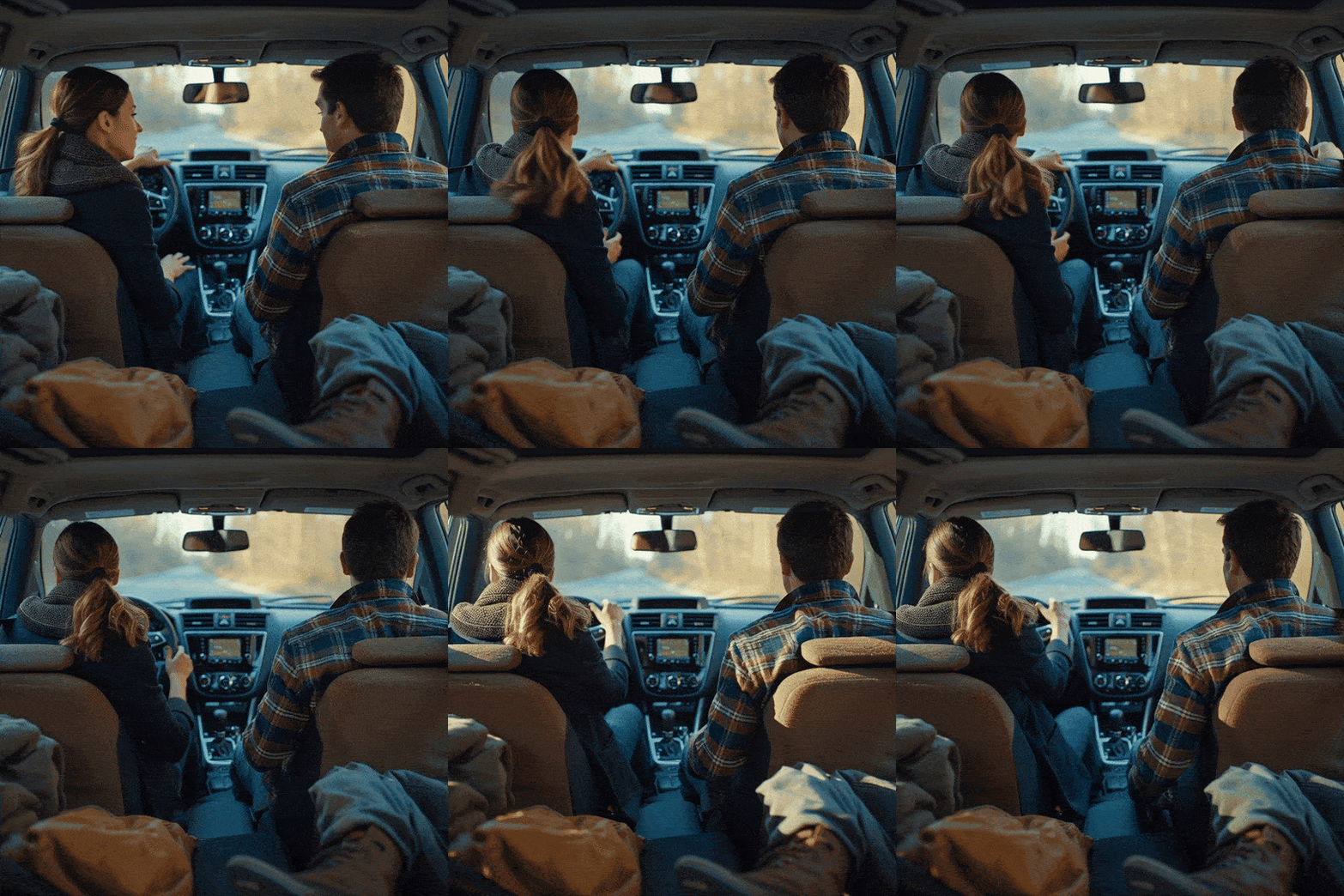
Harlan dug into his jacket pocket, frowned, patted the other side. “Shit.”
“Language.”
“I forgot my charger. The good one, with the long cord.”
Elena glanced over, one eyebrow arched. “The one you said you packed last night?”
“Yeah, well. I was distracted.”
“By what?”
“By you yelling at me to pack faster.”
She let out a soft huff that might have been a laugh. “There’s a spare in the glove box. You’ll survive.”
He opened the glove box, found the coiled white cord, and held it up like a trophy. “Look at you, always prepared.”
“Someone has to be.”
Harlan folded his long frame into the passenger seat, boots on the dash.
“Feet down,” she said automatically.
He dropped them with an exaggerated sigh, then reached for the radio. “Music?”
“After we’re on the highway. I want to hear if anything sounds off in the engine.”
They hit the interchange for I-65 south—big green signs pointing toward Indianapolis, Louisville, beyond. The city thinned behind them; concrete gave way to flat, frost-dusted fields under a low sky. The hum of tires on highway settled in, steady and endless.
Harlan stretched, cracked his neck. “So. Four days of this. You sure Grandma couldn’t have flown up for Christmas like a normal person?”
“Your grandmother hasn’t flown since 1987,” Elena said. “And she’s lonely down there. Dad’s gone, her friends are moving away or passing. She needs family.”
Harlan nodded, gaze on the passing semis. “Yeah. I get it.”
A comfortable quiet stretched for a few miles. Elena reached forward, tuned the radio to a classic-rock station, volume low.
Harlan drummed his fingers on his thigh. “You know, when we get there, she’s gonna ask why I’m not bringing a nice girl home yet.”
“She asks me that every time I call.”
“What do you tell her?”
“That you’re busy building an empire out of whiskey and jukeboxes.”
He laughed, deep and sudden. “Close enough.”
Elena smiled at the road ahead. “She’ll be proud when she sees you, Lucas. Just… maybe don’t tell her about the time you almost got arrested for climbing the water tower.”
“That was senior year. Statute of limitations is up.”
The highway unrolled south, mile after mile. Indiana welcome signs, billboards for fireworks and adult superstores, the first hints of rolling hills in the distance. The Subaru ate up the distance, steady and sure.
The university library smelled like old paper and burnt espresso from the café downstairs. Late afternoon light slanted through the high windows, catching dust motes over rows of silent stacks. Most students had already fled for winter break, leaving the place feeling half-abandoned, like a church after the service.
Mia Reyes pushed through the heavy doors on the third floor, clutching a thin manila folder against her chest. Early twenties, dark hair twisted into a hasty knot, oversized cardigan swallowing her frame—she looked like every grad student who’d ever survived on caffeine and anxiety. She spotted Dr. Edith Clarke halfway up a rolling ladder, one arm full of books, the other reaching for a high shelf.
Edith was balanced precariously, linen shirt untucked, silver earrings flashing as she stretched. Forty-seven, but she moved like someone who refused to act her age—graceful, impatient, a little dangerous. Her reputation preceded her these days: the professor who made department heads sweat in meetings.
Mia cleared her throat softly. “Dr. Clarke?”
Edith glanced down, recognized her, and smiled with real warmth. “Mia. Perfect timing. Help me down before I break my neck and give the dean an early Christmas gift.”
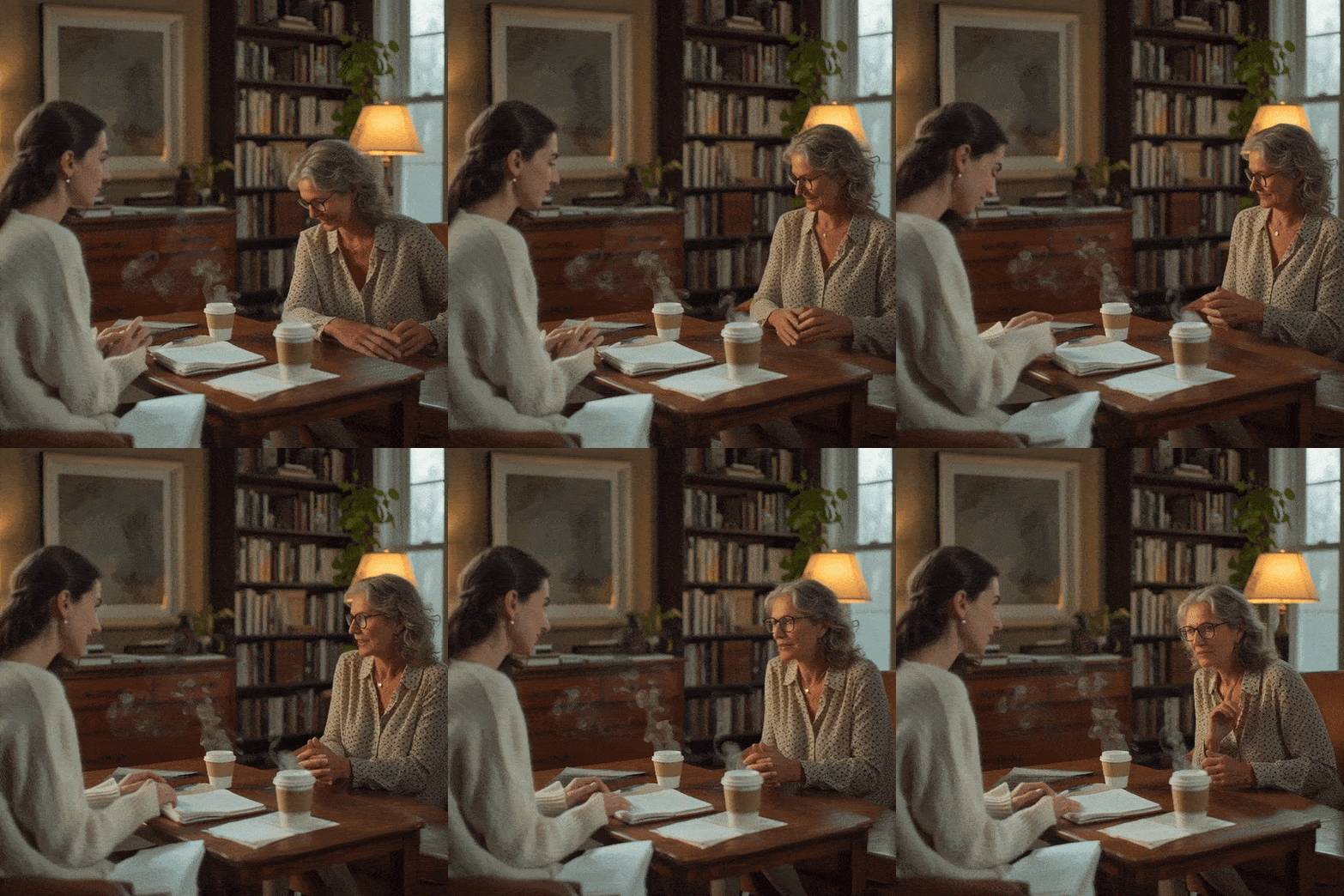
Mia hurried over, steadying the ladder as Edith descended with an armload of dusty volumes. They migrated to a nearby study table tucked between shelves—private enough, dim enough.
Edith dropped the books with a thud and flopped into a chair, rubbing her lower back. “Lord. Remind me never to volunteer for reshelving again.” She pulled out her phone, thumbs flying. “Coffee. We need coffee. You want?”
Mia nodded, sliding into the opposite seat. “Sure. Um… regular with oat milk?”
“Done.” Edith tapped order, then set the phone face-down. “So. You have that look. The one that says you’re about to deliver news I already know.”
Mia’s mouth twitched, half-smile, half-wince. She opened the folder and slid a single sheet across the table. Official letterhead. “Your resubmission to Evolutionary Psych Review… they denied it. Again.”
Edith didn’t even glance at the paper. She leaned back, amused. “Of course they did.”
Mia laughed under her breath, cheeks coloring. “I mean… I kind of thought they would. The stuff you wrote—it’s… bold.”
“Bold,” Edith repeated, savoring the word. “That’s the polite version. Most of them used ‘irresponsible,’ ‘unethical,’ and my personal favorite—‘likely to inflame public misunderstanding.’” She shrugged. “They’re not wrong about the last one.”
Mia leaned forward, elbows on the table, curiosity winning over shyness. “So why bother resubmitting? You had to know.”
Edith’s eyes sparkled. “Because good research isn’t written for committees with delicate sensibilities. It’s written to be read by neutral eyes. Social morals make terrible referees.”
Mia shook her head, still grinning. “I just… how do you even believe this stuff? Like, really believe it enough to keep fighting for it?”
Edith opened her mouth to answer just as the library doors swung open again. A student worker in a campus café apron appeared, balancing two paper cups.
“Dr. Clarke? Large dark roast, oat-milk latte?”
“Bless you,” Edith said, tipping him five bucks from her pocket. The kid vanished as quickly as he’d come.
They each claimed their coffee. Steam curled between them.
Edith took a slow sip, eyes half-closing in pleasure. “Tell me something, Mia. You like coffee, right?”
Mia cradled her cup. “Yeah. Sure. Addicted, probably.”
“Every time you take a sip,” Edith said, “your brain gives you a little involuntary hit of dopamine. Tiny reward. Makes you want the next sip. You don’t decide to feel good—it just happens.”
Mia smiled, amused. “Yeah, I guess.”
Edith leaned in slightly, voice lowering even though the library was empty. “Exactly like that, the body releases cascades of other hormones—oxytocin, vasopressin, testosterone, estrogen—triggered by certain actions, certain senses. Visuals. Scents. Proximity. It’s not choice. It’s not morality. It’s just… natural.”
Mia held her gaze for a beat, something flickering behind her eyes—curiosity.
The dark blue Subaru Outback sat on the gravel shoulder of I-65 south, somewhere past Lafayette, Indiana. Hazard lights blinking lazy orange. Semis roared by, rocking the car slightly.
Steam curled from under the hood in lazy white ribbons, vanishing into the cold Indiana sky.
Harlan had the hood propped open, sleeves shoved to his elbows, face already smudged with a streak of grime. He squinted at the radiator cap like it had personally insulted him.
Elena stood a few feet away, coat zipped to her chin, phone tilted toward the sky as she hunted for signal. The map app finally loaded—slow, stubborn bars.
“Great,” she muttered. “Forty-three minutes to the next exit with services.”
Harlan poked at a hose with the cautious optimism of a man who once rebuilt a jukebox but had never touched a Subaru engine. “It’s just low on coolant. We top it off, let it cool down, we’re golden.”
Elena lowered her phone, eyes narrowing. “You run a bar, Lucas, not a mechanic shop. Maybe don’t play surgeon on my car unless you want us stranded till New Year’s.”
Her voice had that razor wrapped in velvet—sharp enough to cut, soft enough most people didn’t notice the blood until later.
Harlan straightened, wiped his hands on his jeans, and flashed the slow, lopsided grin that usually got him out of worse. “Relax, Mom. Worst case, I flood the engine and we hitchhike with some nice trucker named Bubba. He’ll probably have better stories than Dad anyway.”
Elena’s mouth twitched despite herself. She exhaled, fogging the air. “I’m sorry. That was… mean.” She gestured vaguely at the car. “I just hate feeling stuck.”
“Yeah, I know.” He shrugged, already forgiving. “You get hangry when civilization’s more than ten miles away.”
She rolled her eyes, but the edge was gone. “There’s a lake on the map—half a mile that way, through the trees. Take the empty jug from the trunk and get some water. Cleanish water, not swamp sludge. We’ll use it to limp to the next station.”
Harlan saluted with two fingers. “Yes, ma’am. Explorer Harlan reporting for duty.”
He grabbed the big blue plastic jug from the cargo area, gave her a mock bow, and started across the ditch toward the tree line. His boots crunched through frozen weeds, figure shrinking against the gray horizon.
Elena watched him go, then glanced at her phone again. Thumb hovering over Richard’s contact. She could call, tell him they were delayed, listen to him fret and offer solutions from his desk downtown. Rich meant well—always did—but half the time his fixes felt like reading instructions off a pamphlet. She loved him for trying, but sometimes it just reminded her how much she carried alone.
She locked the screen, shoved the phone in her pocket. He’d get the update when they had signal again. No point worrying him yet.
The wind picked up, cold sneaking under her collar. She shifted from foot to foot, then felt it—a sharp, insistent pressure low in her belly. Too much coffee at the last stop, not enough bathrooms on this stretch of nowhere.
“Damn it,” she whispered, scanning the empty highway. Semis thundered past every minute or so, but nothing close. The tree line where Harlan had disappeared looked thicker, private.
She cursed under her breath, grabbed a pack of tissues from the glove box, and started across the shoulder in the opposite direction from the lake—toward a cluster of bare oaks that might offer cover.
Harlan reached the lake a few minutes later. It was more pond than lake—half-frozen at the edges, ringed by cattails and dead grass. The water in the middle looked cold and clear enough. He crouched, unscrewed the jug, and dipped it in, watching the air bubbles rise as it filled.
Harlan trudged back through the frozen weeds, jug sloshing heavy in his right hand. His phone was in the left, thumb flicking through the camera roll out of sheer boredom. Shots from last weekend at The Lantern—his buddies lined up at the bar pulling stupid faces, neon beer signs glowing behind them. Older stuff he probably should’ve deleted: grainy pics from college parties, lines on mirrors, shit he wasn’t proud of anymore but hadn’t quite brought himself to trash.
Then Emily. A couple of selfies she’d sent—red-lipped smile, that look she gave the camera like she knew exactly what it did to him. Decent girl, great in bed, but Jesus, the New York thing. Every other week: “We should move, Lucas. Real bars are in Brooklyn.” Like he could just hang a sign on the door and walk away from the place he’d bled for. So he’d ended it clean. She cried, called him selfish, blocked him. Whatever. Wasn’t his first rodeo—girls left, he left girls. Didn’t sting much.
Still. Scrolling past her face, he felt that familiar hollow spot under the ribs. When was he actually gonna settle? Build something that wasn’t just a jukebox and last call?
He pocketed the phone, started whistling some half-remembered Springsteen tune as he climbed the shallow ridge back toward the highway.
Crested the top—and stopped dead.
Twenty yards off, half-hidden by a clump of bare bushes, Elena sat squatted low. Her long wool coat was open, dark dress rucked up around her leg, knees spread for balance.
Then, One pale hand braced on the tree behind her; the other was between her thighs, fingers gently parting herself to aim the stream. A thin, silvery arc caught the weak afternoon light before it spattered into the dead leaves.
The whole thing lasted maybe three seconds, but it burned itself onto Harlan’s retinas like a flashbulb.
Elena shook off the last drops, straightened her panties, and started to stand—then looked up.
Their eyes locked.
For a beat, neither moved. Wind rattled the branches.
Harlan’s face split into a slow, wicked grin—the same one that got him free drinks and out of fights.
“Well, damn, Mom. If you needed a spotter, you could’ve hollered.”
Elena’s cheeks went scarlet. She yanked her dress down in one furious motion, standing so fast she almost stumbled.
“Lucas Matthew Harlan!” Her voice cracked like a whip, half-mortified, half-furious. “Turn around right now!”
He was already backing away, hands up in mock surrender, laughter bubbling out of him. “Turning, turning! Consider me scarred for life!”
He spun on his heel and jogged toward the Subaru, jug swinging, still chuckling like an idiot.
Behind him, Elena’s scolding carried on the wind—“You are Twenty two years old, act like it!”—but there was no real venom in it anymore, just the flustered edge of a mother who’d been caught human.
Harlan reached the car, set the water jug on the hood, and leaned against the fender, waiting for her to catch up, grin refusing to fade.
Elena emerged from the trees a minute later, coat buttoned tight again, cheeks still flushed from cold and embarrassment. She marched straight to the driver’s side, pulling a wet wipe from her purse with the efficiency of a surgeon. She scrubbed her hands once, twice, then balled the wipe and flicked it into a little trash bag she kept hooked on the gear shift.
Harlan was already at the hood, carefully pouring the lake water into the radiator reservoir, steam hissing softly as it met the hot engine. A sheen of sweat had broken across his forehead despite the December chill; hauling the heavy jug back up the ridge had done the job.
Elena stopped beside him, arms folded. “Next time you decide to play voyeur, Lucas, maybe announce yourself like a civilized human being.”
Harlan capped the jug, wiped his brow with the back of his wrist, and turned to her with that same easy grin. “I said I was sorry, Mom. Well… I thought it. Loudly. In my head.”
“You thought it while sprinting away like a twelve-year-old.” She sniffed, but the corner of her mouth betrayed her. “You’re lucky I didn’t throw a rock.”
“Yes, ma’am. Very lucky.” He closed the hood gently, latch clicking. “Engine’s happy now. We’re good to roll.”
Elena glanced at the car, then at him—noticed the sweat darkening the collar of his flannel, the way his hair stuck to his temples. She felt it on herself too: a faint dampness at the small of her back, under her arms. The breakdown, the walk, the mortification—all of it had turned the heater-blasted car into a sauna.
She exhaled, softening a fraction. “Get in before we both freeze.”
Harlan circled to the passenger side, still chuckling low. “Love you too.”
Elena slid behind the wheel, started the engine. It caught smoothly this time, no warning lights, just the steady idle. She let it run a moment, eyes on the dashboard temperature gauge as it crept down from the red.
“We’ve lost almost an hour,” she said, shifting into drive. “We need to make some distance before dark. Bowling Green by seven, motel by eight. No more scenic detours.”
Harlan buckled up, stretched his legs as far as the seat allowed. “Copy that, captain. Full speed ahead.”
She checked the mirror, signaled even though no one was around for miles, and eased back onto the interstate. The Subaru picked up speed quickly, tires humming over the pavement, Indiana flatlands sliding past again.
Behind them, the shoulder faded into gray distance. Ahead, the highway stretched south like a promise—or a dare.