
Work Text:
"I thought you didn't care about...
Doesn't mean I can't appreciate it."
(John and Sherlock, in SHERLOCK "The Great Game")
Sherlock had a small luxury that few knew about and he never really spoke about it, unless the topic came up. Sherlock enjoyed going to art museums. It was not often that playing his violin could not sooth the racing thoughts in his head, but every so often, playing the violin only made the steam-engine that was his mind chug faster instead of slower. In these rare times, Sherlock escaped to the National Gallery.
Sherlock knew more about art than most people would imagine. After all, painting with colours is not very different from painting with musical notes. Sculpting images with one’s hands is not very different from sculpting sounds with a violin and bow. Each achieves its intended purpose: to express with colour, movement or sound when words fall utterly short of such expression.
When Sherlock and John returned from Dartmoor, Sherlock was a bit out of sorts. His experience with the drug and the subsequent doubt he felt had rattled him more than he would ever admit to anyone. He had tried to explain it to John, but without much success. Now, they had been back for two days and even playing the violin was too restrictive for what Sherlock was trying to express. He grabbed his coat and scarf, put them on and left John at the flat with a curt, “I’m going out.”
Sherlock hailed a cab and requested to go to the National Gallery. When he entered the Gallery, he started to wander. To the casual observer, his movements through the different displays probably seemed random. However, Sherlock rarely, if ever, did anything without a specific purpose. He never stayed in one section, nor looking at one specific artist’s work for more than ten minutes. For those ten minutes, he would observe only one artwork at a time. He would allow himself to become lost in it.
Someone who casually appreciated a work of art might see the work as a whole, but Sherlock contemplated the materials that the artist used, the colours, the brush strokes and all those little details that seem lost on everyone else. After all, that was where the interesting aspects remained. Anyone can draw, paint or sculpt their idea of an image they saw in their mind. What made an artist’s work unique is not necessarily their interpretation of a given image, but the methods they applied to express what they saw and felt. It was the only time Sherlock felt like he understood another person. Well, the way he thought others understand each other, at any rate.
Sherlock claimed that sentiment is a chemical defect found on the loosing side. An artist’s expression of their innermost thoughts and feelings is not the same as sentiment. Artwork helped them to think or to process through different aspects of their lives. If Sherlock were completely honest with himself, he would admit that he has more in common with the likes of the misunderstood artists than he did with the likes of brilliant scientist. However, he is not that honest – with anyone – so, it was easier to consider himself in the company of Stephen Hawking than Edvard Munch. In the end, he is what he is and others will see him however they want to, no matter how hard he tried to tell and show them otherwise.

Sherlock stopped in front of one of the works by Claude-Oscar Monet. A small smile twitched and only one name came to his mind as he looked at the work, Molly. The light pastels and subtle strokes lay in stark contrast to the striking dark colours that allowed for contrast reminded him of Molly. So many people considered her mousy – or discounted her altogether. Moriarty and Mycroft both did not see her for the value she holds. Perhaps that was for the best. If others never realized her worth, then perhaps she would be safe from the havoc that Sherlock seemed to bring upon most people he knows.
Like a Monet painting, Molly is not only what he saw on first glance. Looking more closely at the Monet painting, he saw how the different colours layer and blend together to create the various images that appeared. Molly was no different. Sherlock refused to work with any of the other pathologists at Bart’s. Molly really is brilliant when it comes to her work. More than that, he trusts her. He knew, like that Christmas that seem so long ago now, that if he ever needed to be put in his place, she would do it. When Molly called him out on his behaviour, he knew he must heed her words. Molly has never asked him to change his behaviour. She, rather poignantly, showed him how his behaviour hurt her. Of course, he did not realize the pain he caused her until it is too late – he never does. That is only because she always seemed to know him so well. He took for granted that she understood him. He expected her to remember that he always has her best interests at heart, even if he made a mess of expressing them.
Sherlock liked the Impressionists, but it was time to move to something less colourful. Too much colour, too many layers only made his mind go faster. He moved toward the photography section and came across the works of Ansel Adams. As black and white photography goes, it was exceptional; the way the contrast gave depth and perception to the works. However, in the end, it was basic. A picture of a mountain or a tree was still just the image that was presented. Sherlock decided that this was not unlike Sally Donovan and Anderson.
They were both so simple. On the other hand, that was good, for him. He knew exactly where he stood with them. They were – transparent. Obvious. Dull. That is not to say that the work of Adams is dull, for has genius in it its simplicity. At the same time, there was not a lot to ‘figure out’. At least, there was not a lot to keep his mind occupied.
That was the crux of it. He wanted his mind entertained, but not racing. He could still feel the panic of doubt, which was completely illogical. After all, the drug was out of his system. He solved the puzzle. There was no reason for the panic he still felt occasionally surge through his system. He sighed. He was not quite ready to return to the Impressionists yet, so he turned to the Surrealists.
Sherlock came upon a Salvador Dali Exhibit. Sometimes he could get into the Surrealists, but today they made him uncomfortable. They reminded him too much of Mycroft. For as much as he and Mycroft are similar, they are still rather different. The work of the Surrealists is never what it seemed to be. Just when you think you discover one meaning; you blink and another meaning revealed itself. On the positive side, they are never boring and usually held his attention for some time. Sherlock chuckled softly, aware of the other patrons in the gallery. Surrealists can hold his attention when Mycroft, the very epitome of being enigmatic, cannot hold Sherlock’s attention for more than a few minutes at a time.
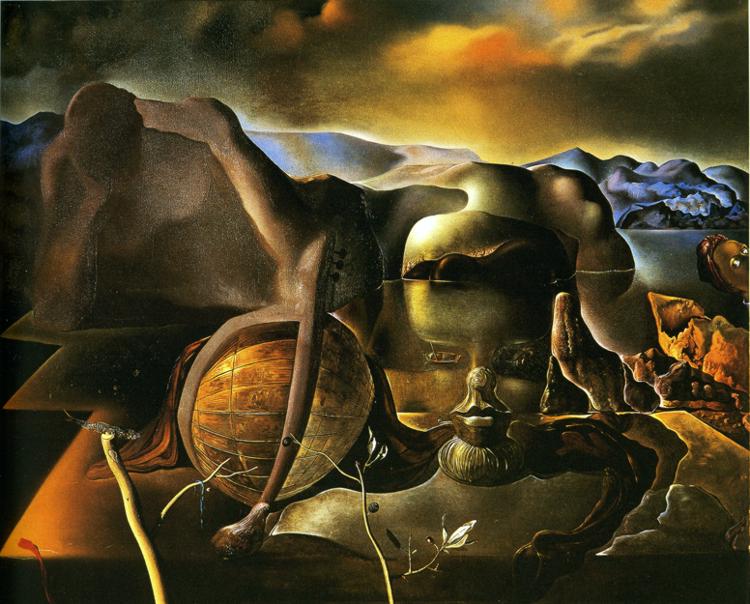
Sherlock does not know when everything changed. Perhaps it was when Mycroft stopped being his brother and started being his parent. Only now, that Sherlock would like to have a sibling again, it is difficult because that relationship has already morphed into something different. Perhaps that is why the Surrealists represented Mycroft. No matter how hard Sherlock tried to understand his brother, the second he thought he had an understanding; his brother revealed that all the rules had changed.
For as much as Sherlock thrived on complexity in cases, complexity in relationships exhausted him. Perhaps that is why the Impressionists comfort him more than the Surrealists do. Something concrete in the work of the Impressionists allows him to quickly wrap his mind around it. This allows him to delve into the deeper meaning of what their work represented. He turned his back on the Surrealists and saw across the way another Impressionist: Edgar Degas. Another small, smile appeared as such an artist could represent only one person in his life: Mrs Hudson.
If ever he had ever encountered a person precisely when he needed to, it was Mrs Hudson. He had been struggling with a recent relapse of his drug habit and an odd side effect had been a desire to be mothered. If he were honest, he would go even farther and say he wanted to have his mother near him. Mrs Hudson had entered his life with the case of her husband. She had no children of her own. With what she was going through with her husband, Sherlock became a surrogate son. They are… good for each other; each fulfilling a role desperately needed by the other.
He approached the work and realized just why this could represent Mrs Hudson. Degas paid attention to the background. Not just in his action scenes, but even in his portraits. If one paid close enough attention, they could see that there is colour where seemingly no colour should exist. Mrs Hudson is like those colours in the background, or more accurately, like another painting, where Degas added a floral design to the background, just because he wanted to add it. Mrs Hudson is always there in the background, simply being herself. Yet, if you took away that background, the picture would be profoundly different. It would not have the same meaning or be as interesting. Sherlock once said England would fall if Mrs Hudson ever left Baker Street. More precisely, Sherlock’s entire world would be more dismal without her.
Sherlock again turned and came face-to-face with some of the classic artists. Rembrandt was first and oddly, his work reminded Sherlock of The Woman. What reminded Sherlock of her was the way that Rembrandt played with light and dark to highlight different aspects of his works. By using light and dark, he was able to show you what he thought was important about his work of art. However, his attention to detail allowed one to look at his works carefully and see what he had placed in the darkness. Regardless of a story Rembrandt captured, he was adding to the story, perhaps even inviting you into it. To dig deeper and suggest that more was happening than you might expect. Irene Adler was like that. She captured his imagination.

He chuckled softly as he thought about that moment he first saw her as she entered that room naked. As he reflected, he realized it was probably a wise decision on her part because there was not much for him to see. To an extent, she was completely transparent. There were no clues to help him with his deductions. It had frustrated him tremendously, but in the end, her transparency allowed him to figure out her lock code. He was glad John had not witnessed that deduction. He was quite certain that John would have considered him cruel. However, she had tried to play him. She had used his intrigue of her against him. He only offered to her what she had done to him. He was not completely heartless. He had monitored her and helped her to fake her death properly once he felt she had learned her lesson.
Sherlock sighed and turned into another section. This one had various works of Michelangelo. He smiled as he thought of Lestrade. Sherlock fully believed that at some point in the future, Lestrade will be looked to as an example for younger Detectives to follow. It was one of the reasons why Sherlock worked with him. Out of the entire Yard, he is probably the most intelligent. That is not saying much, but when he looked at the works of Michelangelo and thought about how some of his contemporaries treated him, well, the parallel cannot be denied. Lestrade could be a genius, but he would not beat you over the head with it. You either accepted him or you did not, but he will do whatever it takes to perform his duty to his own standards.
Michelangelo’s work is like that. That sounds funny, since most people only think of the likes of the Sistine Chapel or the statue of David. The colours he used were at once, vibrant and translucent. In today’s era, people might say they look ‘cartoony’. However, his attention to other details, the way skin and muscles stretched over bones, is what captured Sherlock’s attention. That too reminds him of Lestrade, not because of anything the Detective did for his job, but because of what he did for Sherlock personally. Lestrade took him under his wing when Sherlock had given up on himself. In those days, drugs were the only things that stopped…. No, must not think on that now…. Perhaps another day…. In the end, as Michelangelo breathed life into the Sistine Chapel, Lestrade gave a life to Sherlock.
The exhibit opened to another: DaVinci and Sherlock’s pulse heightened. DaVinci could only represent one person: Moriarty. Only DaVinci could represent someone as diverse as Moriarty. Because Moriarty is as diverse as DaVinci. In the same way that DaVinci was an artist, inventor and scientist, only he could represent Moriarty. DaVinci fascinated Sherlock and so did Moriarty. They are both like puzzles that need to be solved. They are both geniuses and each in their own right, they are both completely mad.

Sherlock moved on. He did not come here to dwell on Moriarty. He found another room of Impressionists and this one contained Vincent VanGogh. For a few moments he positively beams. This was clearly John. With striking colours and strong brush strokes, he still accomplished delicate images. VanGogh’s works operated within the constraints of creative tension. Much like John: a doctor and a soldier. A man who could kill without a second thought, but who would have nightmares for years about those he could not save.
It was a contradiction in terms, much like VanGogh himself. A man who could create such amazing works, considered a failure in his own time and the depression that ate him alive – quite literally. Sherlock sighed. If the world were only a bit more tender…. As he stood there looking at the works of VanGogh, he realized what he has in common with John. In a sense, they are both working themselves towards unemployment. For if there are cures to all illnesses, there is no need for a doctor. If there is peace, then there is no war and no need for a soldier. In Sherlock’s case, if there is no crime, there is no need for a detective. Sherlock had once said, “The frailty of genius is that it needs an audience,” in no case was this more clearly exhibited than in that of VanGogh. John Watson is a genius too, in his own way. However, his gratification was always attained a little more directly. As a doctor and soldier, he either saved or killed people. So he knew instantly whether he is a success or not. He does not have to rely on others to express their awe.
VanGogh used paint to describe his world; John used actions. In both cases, Sherlock’s world was a little more vibrant because of their existence. He wondered if VanGogh would have self-destructed had he known the impact he would have on the world. Then Sherlock thought about what happened to John when the gas had affected him. Sherlock nodded grimly to himself. Some things cannot be cured, you can only let them run their course and hope for the best. For all the light and vibrancy of many of VanGogh’s works, there is darkness as well. His depression was always there, operating as an undercurrent through the darker paints he used. Sherlock thought about the darkness that runs through John and hoped that he will never see the day that darkness is the stronger influence in John’s life.
Sherlock’s thoughts turned dark again as he thought about the darkness in VanGogh and John. This was not why he came here. Again, it was time to move on. He decided that maybe he should just return home. Perhaps his mood was too dark and he should just accept it. He began to make his way out of the gallery. As he was leaving, he came across a small display that made him feel completely at peace: M.C. Escher.
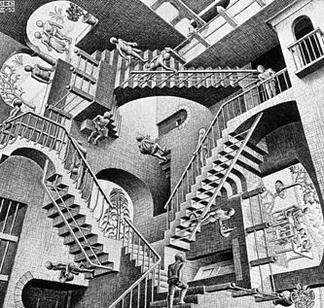
This artist’s works represented Sherlock himself. Not only were they mathematically accurate, but also they were simple etches. Sherlock considered himself rather simple. Others would see that, if they just took the time to realise it. Of course, he was just as complex at the same time. Looking at “Relativity,” was like a window looking into the way Sherlock’s mind operated. That is not to say it was reflective of his Mind Palace, far from it. It was more representative of the actual way his mind functioned and processed information. Oh yes, completely confusing and mental to anyone on the outside looking in, but it makes all the sense in the world to the person residing there.
Sherlock took a calming breath, no longer feeling quite so afraid of the world and left the Gallery. On his way home, he realised that what happened in Dartmoor was simply a warning that he should never be complacent in himself. He chuckled as he hailed a cab for the ride home. He was still a young man and there was time enough. He still had things to learn about himself and there were still opportunities for growth. He might be a genius about some things, but not even he knew everything – yet.