
Chapter Text
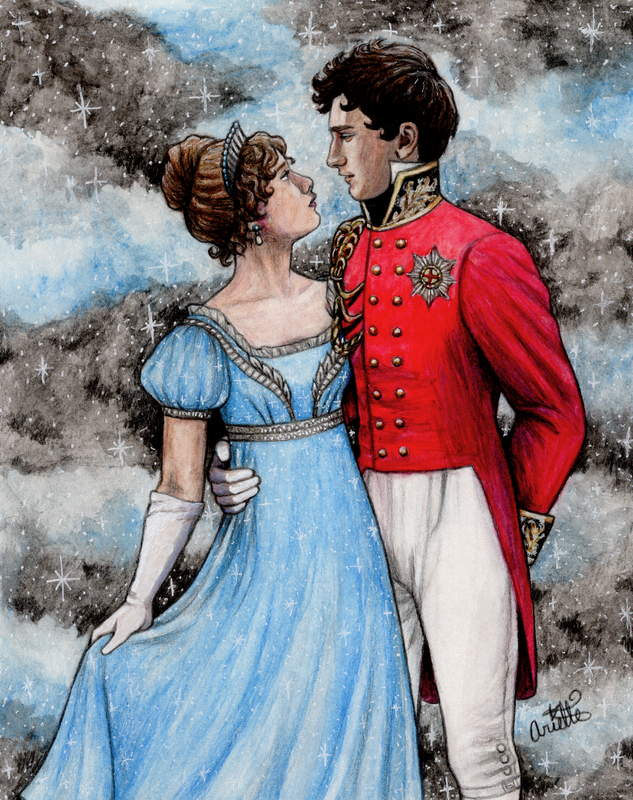
‘Lavender blue and rosemary green,
When I am king you shall be queen;
Call up my maids at four o'clock,
Some to the wheel and some to the rock;
Some to make hay and some to shear corn,
And you and I will keep the bed warm.’
- Songs for the Nursery, 1805
---
When Lucy Carlyle was a little girl, she believed in fairy tales.
Her governess was a fairy, after all. Ivy was kind and loving, with nut-brown skin, loam-black hair, and a magical twinkle in her eye. She read to Lucy every night from a book bound in blue and embossed in silver leaf, its well-thumbed pages containing stories that began with ‘Once upon a time, in a faraway land…’ and ended with ‘they lived happily ever after.’ Often the plot revolved around an oppressed girl destined to be a princess and a brave prince determined to save her. There were no ghosts to contend with; just flesh-and-blood villains who received their comeuppance. After a tale was finished, Ivy would tuck Lucy into bed and sing ‘Lavender Blue’ until she drifted off into dreamland.
If only she could have stayed there. The existence of Visitors was an ever-present horror, sobering even the most avid reader. When Lucy turned thirteen, her father hired a girl of the same age to help in the kitchen and guard the manor from ghosts. Norrie White’s tangled red hair, galaxy of freckles, opinionated nature, and abject poverty would have generally made her an unsuitable companion for the daughter of a wealthy merchant, but they became fast friends regardless. Mr and Mrs Carlyle paid no mind; they were neglectful parents at best, inclined to drink and excess, and the friendship kept their daughter occupied so they could continue in their habits.
In truth the girls were a trio, for Ivy had a daughter named Holly who was two years older than them. Thicker than thieves they all were, learning swordplay from Norrie and giggling together in the garden. Many a late afternoon was spent beneath the shade of the apple tree, where Ivy read aloud fiction and poems, brought histories and sciences to life, and did her best to make maths even remotely interesting. Art was a favorite subject, and Lucy excelled at it. Ivy gifted her with a sketchbook and taught her how to study nature in order to mimic it, capturing the spirit of animate and inanimate subjects in charcoal and watercolor. Picnics were common on fair days, and at that time food was plentiful; apples, strawberries, sandwiches, cakes, lemonade. They would eat until they started feeling sleepy, and Ivy would hum her lullaby as they drifted off, weaving them into a world of magic and mystery.
Magic, however, doesn’t always last, and fairies are as susceptible to illness as humans. Ivy died of consumption when Lucy was fourteen.
Much to Lucy and Norrie’s dismay, Holly was sent away to live with her cousin. Fairies could gain employment as governesses or servants, but they were mistrusted simply because there had never been a fairy Visitor in all thirty years of the Problem. Many believed they were soulless. Ivy had explained that fae souls were so interwoven with nature that they simply returned to it, fated to be reborn as a butterfly or flower or even a fairy once more. Mr and Mrs Carlyle, however, were of the first school of thought.
A few months later, Mrs Carlyle fell ill and was confined to her bed. Her good friend, the widow Lady Marissa Fittes, arrived with her fourteen-year-old daughter Penelope to care for her. Marissa gave a teary account to the Carlyles of how the late Lord Fittes had squandered her fortune, and they’d been forced to sell all they owned to creditors. In a rare moment of pity, Lucy’s father welcomed them into the household, which Marissa thanked him profusely for with a flutter of her eyelashes. It was the first of many sultry looks cast in his direction, accompanied by lingering touches. Marissa wasn’t conventionally beautiful, but she knew how to catch a man’s attention, and Mr Carlyle was hooked in her claws like a doomed fish.
Six months after Mrs Carlyle succumbed to her illness and passed on, Mrs Fittes and Mr Carlyle were married.
That evening, as the groom stumbled home from a celebratory night at the pub, he was crushed under the wheels of a runaway carriage. Salt and iron were strewn on the road where he had fallen, and it was written off as an unfortunate accident.
Lucy couldn’t prove it, but she was sure that her new mother-in-law, who sobbed theatrically into her handkerchief at his funeral, was responsible. Perhaps Marissa had hired the carriage that killed him. Lucy harbored little affection for her father—though negligent, he could fly into an abusive rage if bothered while he was drunk, and she’d learned to completely avoid him—but she feared Marissa might be worse.
Marissa’s hawkish gaze followed her everywhere, sizing her up. Insults were next; she made sure Lucy knew that she wasn’t nearly as pretty as alabaster-browed, raven-haired Penelope, that no man would want her, and it was better if she focused on working.
Marissa herself had no such focus. As soon as her mourning period was over, she hosted lavish parties and spared no expense on herself and Penelope, purchasing silk gowns and jewelry and whatever else their hearts desired. Penelope whined that she required more space for her belongings, and Marissa forced Lucy from her own chambers in favor of her stepsister. The drafty attic was given to her as her lodging.
Norrie was always nearby to commiserate, calling Marissa and Penelope a slew of derogatory names—though out of earshot to save both their skins. It lightened Lucy’s spirits, but her happiness was to last only a season, for Norrie was killed by a wandering butcher's ghost that winter.
Funerals weren’t a luxury for a servant who had no kin. Lucy mourned alone by the grave in the paupers’ field, then went home and, on Marissa’s order, cleared anything from the house that could become her Source. The fairy tales Norrie had loved most were burned, and in the moment, Lucy was glad to watch their creamy pages spark orange and blacken, crumpling into hoary ash. No prince had saved Norrie, and no prince would save her.
She was alone.
A month later, expenditures at last toed the line of bankruptcy. Marissa dismissed the household staff and employed Lucy as maid, cook, and ghost defense.
At first Lucy rebelled by burning the food and making more of a mess, but after a painful beating, she strove to be passable in both skills. Her ghost fighting, on the other hand, improved with her Listening, and Carlyle Manor was likely the safest house in all of England by the time she had cleared it and its grounds. The villagers began to hire her to rid their property of Visitors as well, which brought in an income that Marissa promptly wrested from her to supposedly pay for Lucy’s expenses. After eating porridge for dinner the fourth day in a row and having to patch yet another threadbare hole in her best dress, Lucy wasn’t quite sure what these expenses were.
When she was older, she decided, things would be different. When she was of age at twenty-one, she would be free.
---
1815
“Cinderlucy!! Mum wants breakfast!”
The singsong voice echoed up through the house and pierced the rafters of the attic, shrill as a bell.
Lucy woke up angry. It wasn’t an unusual state for her to be in, but the nickname Penelope used when she most wanted to annoy especially grated on Lucy’s nerves this morning. She’d like to see the pampered girl tend the fire without getting ash on her skin or clothes. Not that Penelope would even touch a poker, for fear it would ruin her soft, callus-less hands.
Lucy often dreamed of running away. She and Norrie had frequently talked about going to London, despite the fact that traveling alone, as single young ladies without a male escort, was a questionable endeavor. Not to mention that no London agency would employ them without references. She could perhaps find work as a maid, but that was hardly different than what she was now.
Lucy grumbled as she tied on stockings, laced up her worn boots, and tightened her stays over her chemise. She noticed with irritation that her work dress was going to need more patches. After hiding the holes with an apron, she clomped downstairs to the kitchen, slamming pans to vent her frustration. Breakfast wasn’t particularly pleasing to the eye that morning, but Lucy didn’t care. She climbed the steps to the dining room.
Marissa leaned forward at the head of the table, high cheekbones already rouged, aquiline nose no more minimized by her face powder. She laced her fingers together and rested her sharp chin on them. “Lucy, in future, could you bring the meal before your family dies of starvation?” Her tone was sickly sweet.
“Or you could get it yourself,” Lucy mumbled.
“What was that?” Marissa’s eyes flashed. She was known to slap her stepdaughter quite hard in instances of disobedience, drawing blood whenever she wore bejeweled rings. There were several such rings on her fingers now.
“Yes…Stepmother,” Lucy said through clenched teeth, unloading her tray onto the table.
Penelope grinned as she cracked the shell of the egg in front of her with delicate taps of her spoon. She was the perfect picture of deportment, her back stiff as a board.
“That’s better. Now, away with you.” Marissa waved Lucy off with her fork.
Lucy was happy to leave. She ate her meager breakfast—they weren’t made of money anymore, or so Marissa told her—in the kitchen, with a solitary mouse for company.
It was a rather unusual mouse. Not just because of its bone-white fur with dark splotches only around the eyes and nose, or because no other small creature dared enter the house whilst it was in residence.
“Are you going to give me that cheese or not?” The mouse demanded, his words pressing into Lucy’s mind.
Lucy rolled her eyes. “When haven’t I, Skull?” Perhaps it was a strange name for a mouse, or rather, the ghost of the young man that possessed the mouse. A highwayman once upon a time, named so to hide his true identity, who’d been double-crossed, beheaded by his own band, and left to rot in the road. Ivy had happened upon him as his soul lingered above his slain body and taken pity. A short conversation made her realize he was a incredibly rare Type Three, which only fairies—and, they later discovered, Lucy—could converse with. With a dash of magic Ivy had transferred his essence into a mouse that had been skulking nearby, additionally granting him the longevity of a human lifetime.
But Ivy had died, so now Skull was Lucy’s responsibility. As terrible of a person as he had been in his first life, and as much as the two bickered, Lucy was glad he was around.
“There’s always a first time for you to neglect me.” Skull’s harsh tone was dulled by the cute twitching of his tiny nose.
“Good Lord, you’re as needy as Marissa and Penelope!” Lucy sliced the small mound of cheese that was meant to be her own portion and placed it on the stone floor in front of Skull.
“Don’t compare me to those witches,” Skull spat. He snatched up the cheese and nibbled on it.
Lucy shrugged. “Don’t act like one then.”
Skull mumbled a litany of curses, but Lucy only shook her head and set to work on the washing up.
“You know, it’s my birthday today,” she said with a sigh.
“I’m not going to throw you a soirée, if that’s what you want.”
“Right, because I expected a soirée from a mouse.”
“It could happen.” Skull chewed thoughtfully. “Isn’t it your twenty-first? Don’t you have big plans for this year?”
“I used to.” Lucy looked at her reflection in a silver serving dish. Round, red face framed with drooping sweaty locks of hair piled haphazardly atop her head, soot streaked across one cheek. Marissa often said prettiness wasn’t her trade, and she was right. “I suppose London was always just a dream.”
“Coward.”
“Realistic. I’ve no money, no standing, and I’m a woman. I’d probably end up in a ditch.”
“That’s not the Lucy Carlyle I know. What happened to her, the one who used to laugh in the face of both tradition and danger?”
“She died.” Lucy stopped scrubbing and rested her palms on the edge of the basin. Her muscles felt like they’d been wrung out and hung to dry.
Skull was uncharacteristically silent for a moment. “Happy birthday, dead Lucy. I suppose you can have the last nibble of my cheese as a gift.”
A smile teased at the corner of Lucy’s mouth.